In March 2024, an OEM customer called me from a warehouse floor. They were building a remote monitoring cabinet for solar inverter sites—or rather, the cabinet would sit next to the inverter and stream data back to an operations center. Fourteen cabinets were ready to ship in 48 hours. All fourteen had an APC UPS ES 550 installed inside. Someone had finally added up the loads: each cabinet drew 420 watts. The ES 550 is rated for 550VA and 330 watts. The person on the phone asked if I could somehow make it work.
I've been coordinating urgent power-protection orders for more than six years, and I've handled 300+ rush orders in that time. The product rarely causes the emergency. The way we read a spec sheet causes it.
The Surface Problem: A UPS Catalog Looks Like a Power Strip Spec
Open any UPS catalog and you see rows of models with model number, VA, watts, outlets, runtime, price. It looks simple. The first line for the APC UPS ES 550 says 550VA, and if you're in a hurry, you stop there. A 420W load should fit into a 550VA box, right? Wrong. VA and watts are not two names for the same thing. The ES 550's real power limit is 330W, and a 420W load exceeds the UPS capacity by almost 30%. No amount of “but it's 550” changes that.
In my first year doing this, I made a version of this mistake with a different model. I saw “VA” and read it as watts, approved a quote, and cost my company around $600 in redo fees. I learned the hard way that a catalog summarizes a product, but a datasheet is what defines it.
The Deep Problem: We Bring the Wrong Spec Sheet Template
Here's where it gets less obvious. Most B2B buyers bring a mental template from their own industry. If you're looking for a solar inverter specification guide, you see MPPT voltage range, maximum DC input, maximum AC output current, efficiency curves. Those specs define how an inverter turns DC into AC under normal conditions. A UPS spec sheet answers a different question: how much continuous power can it supply when utility power disappears, and how fast can it switch to battery? When people mix those two frameworks, they pick a UPS the way they'd pick a solar inverter—by the biggest input/output number on the first page. That selection method fails in the field.
For a solar inverter OEM adding a UPS to a control cabinet, reading a solar inverter specification guide is necessary. It is not sufficient. You also need the UPS datasheet, and you need to know which numbers from each sheet apply to continuous conversion and which apply to an exception. A PV inverter's efficiency is measured under test conditions and assumes it's doing its normal job. A UPS's watts rating assumes the grid has failed, the battery is discharging, and the output stage is doing something it wasn't designed to do for very long. That's why runtime curves matter.
Here is another layer I see on almost every emergency call: the list of “features” at the top of a catalog is not the same as the list of limits. The APC ES 550 can be described in two lines: 550VA and 330W. The full spec sheet adds transfer time, waveform, runtime at different load points, battery recharge time, operating temperature. If you only read the first line, you're buying a number that was chosen for naming convenience, not for engineering.
Runtime Charts and the 420W Example
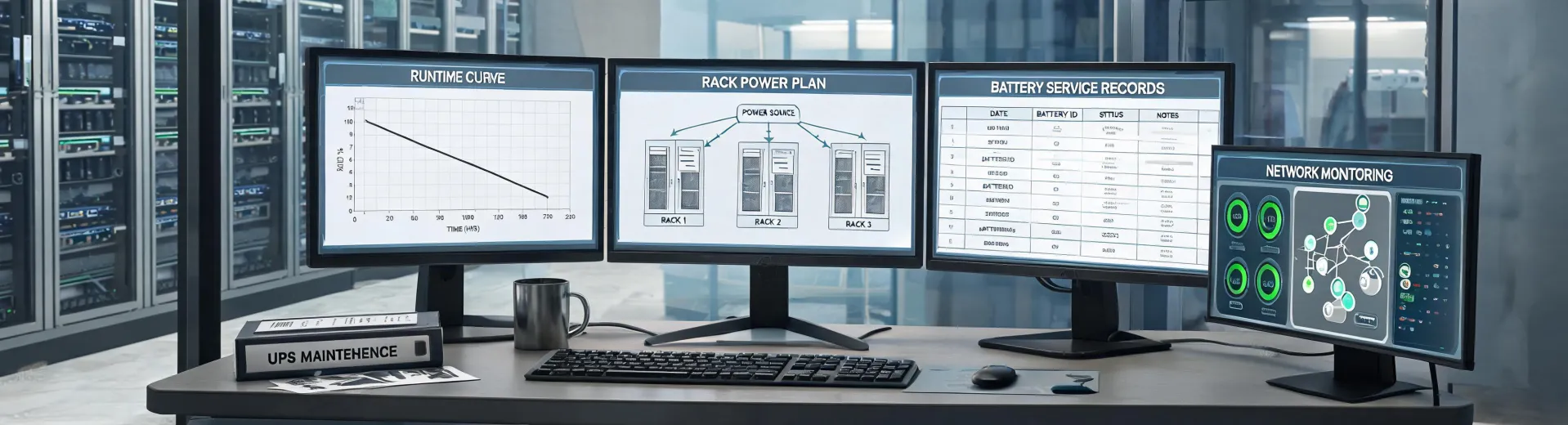
Runtime is the part people guess instead of read. The ES 550's spec sheet includes runtime numbers based on load. At a small network load, it can hold things for a while. Near its 330W maximum, that runtime drops to a fraction—often only a couple of minutes, just enough for a controlled shutdown. If your equipment needs 30 minutes of ride-through, an ES 550 is the wrong model even if the load is within 330W. The catalog page might show one runtime at one load level; the datasheet shows enough to make a smart decision. If you're buying from a catalog, ask for the datasheet before you add to cart.
Back to those fourteen cabinets. The OEM chose the ES 550 because it was $17 cheaper per unit than the next UPS in the APC catalog. They saved $238 on the initial order. But when they caught the 420W mismatch, removing and replacing fourteen units meant more than a quick swap. New mounting plates, new cable lengths, expedited freight, a requalification test—the total was about $1,900. Their ship date slipped by three days, and the internal review process now has an extra line item for checking watt ratings. The real pain was not the money. It was the fact that the 420W number had been sitting in their own test report from the beginning.
“Can't the battery just work harder for a few seconds?” the caller asked. No. The battery in a UPS only supplies what the inverter circuit can convert and deliver. Once the load exceeds the UPS's real-power rating, the unit is overloaded before the outage even happens.
So What Actually Works
Start with real watts. Measure the load with a watt meter, or use the numbers from a panel test. Then apply a derating factor. I use 20% headroom on top of the measured steady-state load. For the APC UPS ES 550, that means a comfortable maximum around 260W, not 330W. If you need a longer runtime, move up to a UPS with more watt capacity or a model designed for extended runtime. The same discipline applies to any UPS in the catalog.
For solar inverter OEMs, please stop asking for a solar inverter specification guide to spec a UPS. That guide will not tell you transfer time, output waveform during battery operation, or what happens to the load when the AC input is noisy. Ask for UPS application notes and the full technical specification sheet. If a supplier can't explain why the inverter spec and UPS spec are different documents, find another supplier.
I still don't understand why manufacturers put VA in larger type than watts. My best guess is tradition: model names have used VA for decades, and changing the naming convention would cause even more confusion. But after 300+ rush orders with people who accidentally bought the wrong thing, I'll say this: the number in the model name is not the number that keeps your equipment alive. The watt rating is. Read the full sheet. Measure the load. Ask the boring questions. That's how you avoid the emergency that doesn't need to happen.

Rebecca Sloan
Rebecca Sloan is a power distribution and protection analyst specializing in circuit breakers, switchgear, contactors, fuses, surge protective devices, and coordination. She applies IEC 60947-2 breaker requirements, IEC 60269 fuse characteristics, and IEC 61643-11 tests while examining rated voltage, breaking capacity, time-current curves, selectivity, and prospective short-circuit current. She helps engineers and buyers compare protective devices against documented fault levels, installation conditions, maintenance access, and continuity priorities.