Instrument
Identify supported local, USB, dry-contact, and network interfaces for each exact UPS. Record firmware, accessory, address, credential, and time settings in the commissioning baseline.
Observe · Anticipate · Act
Connect backup-power status with the teams responsible for uptime. A useful digital layer turns electrical events, load trends, battery indicators, and service history into decisions that can be assigned and verified.
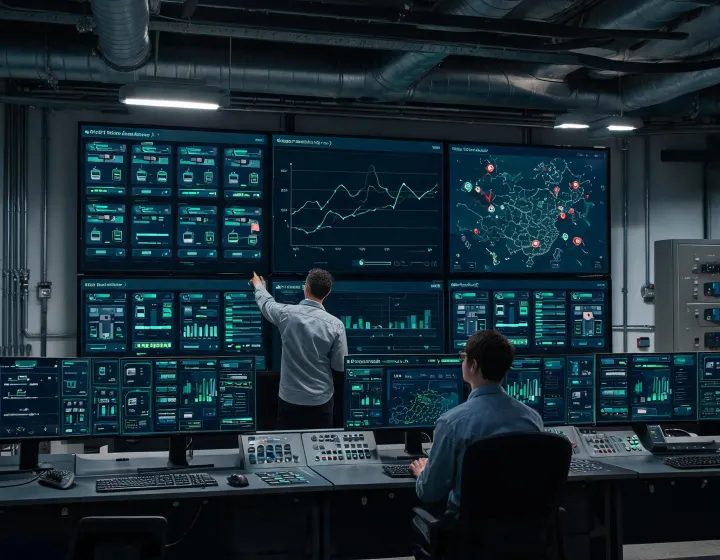
Connected operations roadmap
Identify supported local, USB, dry-contact, and network interfaces for each exact UPS. Record firmware, accessory, address, credential, and time settings in the commissioning baseline.
Group sites by load class, topology, model family, runtime objective, and response policy. Common naming makes alarms and service records understandable across IT, facilities, and contractors.
Send on-battery, low-runtime, overload, communication-loss, bypass, and replace-battery events to defined owners with severity, context, and escalation timing.
Review recurring events, load growth, battery warnings, missed communications, and maintenance completion. Use that evidence to adjust capacity, settings, spares, and response playbooks.
Predictive maintenance is not a promise produced by a single battery indicator. It is a disciplined interpretation of available signals within the limits of the supported device and software. Battery chemistry, ambient temperature, discharge history, self-test behavior, load change, age, and service records all shape the decision. Human review remains essential when data is missing, communications fail, or operating conditions change.
Networked power also introduces governance obligations. Credentials should be changed from defaults, access should follow organizational policy, firmware decisions should be controlled, and alarm routes should be tested. Monitoring that nobody owns is only another silent failure mode.
Integration begins with supported protocols and accessories on the exact model, then connects each data path to a defined operating role.
Coordinates graceful shutdown, event visibility, credentials, and incident escalation for servers and network equipment.
Owns power distribution context, room conditions, maintenance access, generators, bypass procedures, and contractor coordination.
Use configuration records, diagnostic events, cartridge identity, site access details, and maintenance history to prepare interventions.
Share the UPS fleet, supported interfaces, current alarm path, maintenance process, and the operational questions your team needs the data to answer.
Request a Smart Power Review