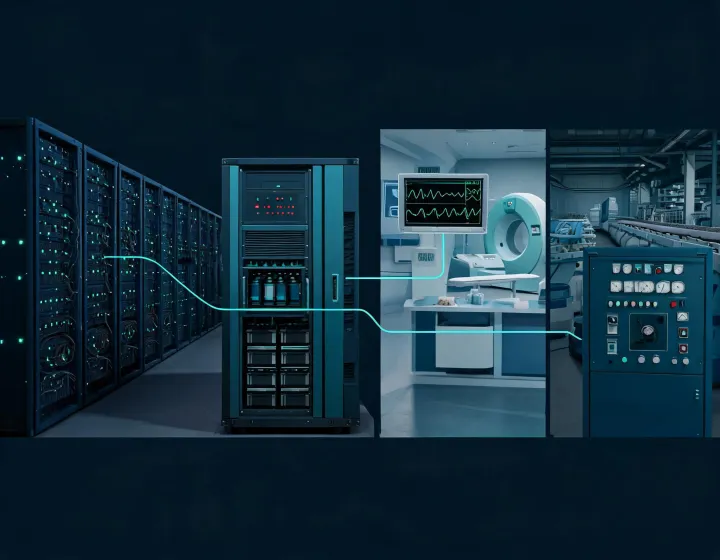
Six environments, six different failure conversations
The matrix highlights the engineering question that deserves priority in each setting. Final design still depends on the exact load, electrical distribution, local codes, operating procedure, and model documentation.
DATAData centers and edge racks
Coordinate rack density, dual-corded loads, network management, graceful shutdown, bypass strategy, and generator transition. Runtime should reflect the site recovery plan rather than a default marketing interval.
Primary question: visibility under distributed ownershipHEALTHHealthcare support systems
Separate clinical continuity requirements from ordinary IT backup. Review applicable regulations, circuit classification, service procedures, alarm response, and the consequence of maintenance or bypass states.
Primary question: operational criticality and governanceAUTOIndustrial automation
Protect PLCs, industrial computers, network switches, instrumentation, and control power from disturbance. Check inrush, grounding, harmonics, enclosure conditions, temperature, and shutdown sequencing.
Primary question: controlled process recoveryBUILDCommercial buildings
Support network closets, access systems, building controls, and communications with clear maintenance ownership. Space, noise, receptacles, battery access, and dispersed alarm handling often govern the choice.
Primary question: maintainability across many roomsRETAILRetail and branch networks
Keep transaction, connectivity, and local compute systems stable during short disturbances. Standardize load profiles, replacement cartridges, remote alerts, and instructions that non-specialist staff can follow.
Primary question: repeatable fleet operationsTELECOMTelecommunications and security
Assess runtime, DC and AC interfaces, remote monitoring, environmental exposure, maintenance windows, and communication paths for switches, gateways, recorders, and access infrastructure.
Primary question: alarm reachability before dispatch Cross-application requirements
Electrical: nominal voltage, frequency, load watts and VA, power factor, waveform sensitivity, branch protection, grounding, and connection type.
Physical: rack units, depth, ventilation, ambient temperature, ingress context, service clearances, battery weight, and handling route.
Digital: USB or network shutdown, protocol expectations, credentials, time synchronization, event retention, and escalation ownership.