The Day I Learned VA Ratings Don't Tell You Runtime
March 2023. I'm standing in our test lab staring at twelve APC Smart-UPS units, all showing fault lights. My facility manager is on the phone, asking why the scheduled power test just crashed our network rack.
Honestly? I had no good answer. I'd promised him 35 minutes of runtime. We got 11.
Here's what you need to know about me: I'm the guy who handles equipment procurement for a mid-sized logistics operation, and I've been doing it for about six years. I've made some memorable mistakes in that time — including a 2017 order where I bought surge protectors instead of actual UPS units, a $2,000 lesson in reading product categories. But the March 2023 failure was the big one. The one that cost the most, and the one that changed how I evaluate power infrastructure.
If you're buying APC UPS units for a facility, or evaluating UPS options for wholesale, this story might save you a lot more than a restocking fee.
How I Ended Up Ordering the Wrong Units
In late 2022, we started outfitting a new distribution hub. Forty racks, networking gear, a small server cluster, point-of-sale systems, security cameras — the usual mix. I needed uninterruptible power for the whole building, and I needed to move quickly.
My approach was lazy. I looked at what we already ran at the older facility — APC Smart-UPS 1500VA units — and told myself: "That's what we use, so it'll work here too." I opened the UPS catalog, confirmed the model was current, and placed an order for 40 units.
I didn't measure the actual load. I didn't look at a runtime table. And I definitely didn't use the APC UPS runtime calculator — a tool that would have shown me the error in about ten minutes.
(Note to self: free tools are only useful if you actually open them.)
The Surface Illusion: "VA Rating Equals Runtime"
From the outside, UPS sizing looks simple. Match the VA rating to your equipment, done. That's the surface illusion. The reality is that VA rating tells you how much load a unit can support, not how long it can run. Runtime is a curve. It depends on actual wattage draw, battery condition, charge state, and the unit's efficiency at partial load.
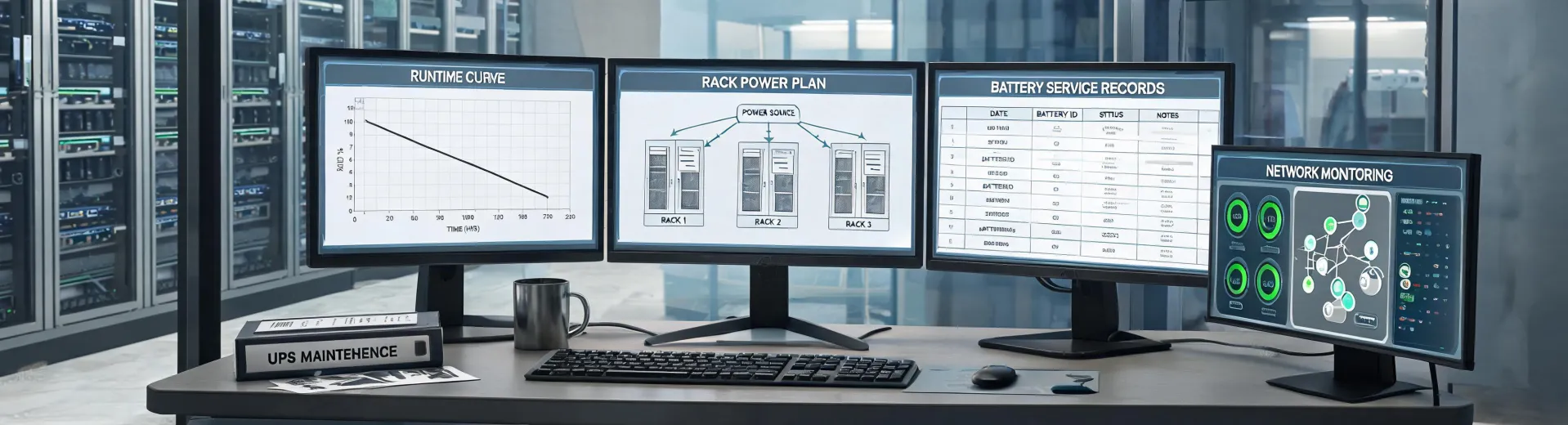
Our actual draw per rack was around 850 watts. At that load, the 1500VA model I'd ordered delivered about 11 minutes of runtime — not the 35 I'd ballparked to my boss. The runtime curve was in the catalog, and I couldn't be bothered to check it before committing budget to the order.
It's tempting to think that a bigger VA number means more runtime. It doesn't. The curve is different for every model, and for every battery type. A 1500VA unit at 850W might run 11 minutes. A 2200VA unit at the same load might run 28 minutes — or might not, depending on the battery configuration. The only way to know is to check the curve.
When I finally pulled up the APC UPS runtime calculator after the failure, it took less than ten minutes to see the numbers, clear as day: at 850W per rack, the model I'd ordered gave roughly 11 minutes. Which, honestly, was exactly what the fault indicators were trying to tell me.
The Parallel Lesson: A String Inverter Supplier
Around the same time, we were also evaluating a string inverter supplier for a rooftop solar array that was supposed to offset part of the building's electrical demand. Different product, same failure mode: the supplier's spec sheet looked perfect at first glance.
We'd requested efficiency data at partial load — the range where the facility would actually operate most of the time. What came back was a datasheet full of ideal-case numbers. Three rounds of emails later, we got the real partial-load efficiency curves. They were lower than the headline numbers. Not a deal-breaker, but a red flag that changed our ROI estimate.
That experience drove the lesson home: supplier documentation is a starting point, not a conclusion. I should have applied the same scrutiny to the UPS catalog's runtime tables.
The Cost of Getting It Wrong
The numbers are painful to repeat, but honestly, I keep them in our incident log and I come back to them often:
- Restocking fee and return shipping on 18 units: about $3,200
- Replacement units with a more appropriate runtime curve: about $11,000 over the original budget
- Schedule delay: three weeks of slippage on the facility rollout
Total direct cost: roughly $14,000. Credibility cost: heavier.
Actually, let me correct myself — it was 18 units returned, not 20. I'm mixing it up with the accessories order. The dollar amount is right, though: $14,000.
My Post-Mistake Checklist for UPS Purchases
Since March 2023, I've kept a pre-purchase checklist for every UPS order. It hasn't caught everything — but it's caught 47 potential configuration errors in the past 18 months, and none of them came close to $14,000.
1. Measure the Actual Load First
Don't estimate. Don't "be generous." Put a watt meter on the rack and log the peak draw over 24 hours. Use that number. My experience is based on about 40 mid-sized equipment orders in a logistics environment. If you're dealing with high-density compute or industrial motor loads, your numbers will be different. The principle is the same: measure first, choose second.
2. Use the APC UPS Runtime Calculator Before You Commit
The APC UPS runtime calculator is free, and it's the fastest way to verify that a model will deliver the runtime you need at your expected load. It's not a marketing tool — it's a sizing instrument. Feed it your load, read the curve, and pick accordingly. I should have used it before the purchase order, not after the fault lights came on.
3. Read the Runtime Table in the UPS Catalog
The UPS catalog is basically a technical document — not just a list of model numbers. It contains runtime tables, transfer times, input voltage ranges, and battery specs. If you're comparing SKUs, build a spreadsheet: model, VA rating, runtime at your load, footprint, battery count, replacement battery cost. That table takes an hour to build and pays for itself the first time it stops you from ordering the wrong unit. Trust me on this one.
4. When Choosing Lithium UPS for Wholesale, Go Deeper Than Price
After the March failure, I started evaluating lithium UPS options for part of our fleet. From the outside, lithium units just look like a premium-priced alternative to VRLA. The reality is that they solve a different set of problems, and they bring a few things you should evaluate carefully.
If you're asking how to choose lithium UPS for wholesale, these are the criteria I'd add to your list:
- Runtime density: lithium typically gives you more runtime per rack unit at the same VA rating. That matters when floor space is part of the total cost.
- Cycle life: lithium handles frequent discharge and recharge cycles much better than VRLA. If your loads cycle often, the total cost of ownership can be lower despite a higher upfront price.
- Battery management system: ask the vendor how the BMS handles load steps, temperature, and end-of-discharge. The datasheet won't tell you. Reference installations will.
I should add that I'm not a battery engineer. My conclusions come from vendor comparisons and my own testing. If you're on the fence, ask the vendor for a reference call with someone running a similar setup.
5. Apply the Same Scrutiny to Every Supplier
Our string inverter supplier evaluation was a reminder that this isn't a UPS-specific problem. Any supplier's datasheet deserves the same diligence. Ask about partial-load performance, operating envelopes, and maintenance intervals. The quality of the answers tells you a lot about the supplier.
The Bottom Line
I don't enjoy reliving March 2023. But I keep the story in our team's documentation because it's useful. The APC Smart-UPS units worked exactly like their published runtime curves said they would. The failure was mine: I picked a product without measuring the load, and I skipped the free tools that would have corrected my course.
The tools to avoid this mistake are free: the APC UPS runtime calculator, the runtime tables in the UPS catalog, and half an hour of load measurement. All of them were available to me from day one. I just didn't use them.
That's the part that still gets me. Not the $14,000. The fact that I had everything I needed to get this right, and I skipped the step where you check the math. Efficiency isn't about doing things fast. It's about not having to do them twice.
This article reflects the author's personal procurement experience. Product specifications and pricing vary by region and time; verify current details with an authorized APC / Schneider Electric distributor.

Rebecca Sloan
Rebecca Sloan is a power distribution and protection analyst specializing in circuit breakers, switchgear, contactors, fuses, surge protective devices, and coordination. She applies IEC 60947-2 breaker requirements, IEC 60269 fuse characteristics, and IEC 61643-11 tests while examining rated voltage, breaking capacity, time-current curves, selectivity, and prospective short-circuit current. She helps engineers and buyers compare protective devices against documented fault levels, installation conditions, maintenance access, and continuity priorities.