I’m the person who buys the office UPS. Every backup unit, every replacement battery, and every surge protector that shows up at our loading dock starts with a purchase order from me. I’ve held this job since 2020, and I think most companies get UPS buying wrong.
Not because they buy cheap. Because they buy by model number and search term, not by specification. I know that mistake personally, because I used to make it.
Quick background: I handle purchasing for about 400 employees across three locations. That is roughly 60–80 orders a year and around $150,000 in spending, spread across nine vendors. I report to operations and finance, which means I hear about it when a product saves money and when a product fails.
In 2024, we consolidated vendors and finally reviewed power protection properly. Here’s what I believe after all those spreadsheets and spec sheets: buying the right UPS starts with questions, not keywords.
Searching “APC UPS 1000VA” Is Fine. Stopping at the Search Result Is Not.
A few years back, a colleague said, “we need that APC UPS, the 1000VA one.” So I typed apc ups 1000va into a search engine and clicked a familiar listing. The unit worked. That’s the frustrating part—it worked until one afternoon in 2023 when it didn’t.
We connected a desktop workstation, a dock, two monitors, and a small PoE switch to it. On paper, the setup looked like it had enough margin. When the power flickered, the UPS gave us about six minutes of runtime. Six minutes is enough for one orderly Windows shutdown, but it is not enough to keep phones and network alive through rolling outages. Nobody had calculated the runtime at the real load. That was my job, and I had skipped it.
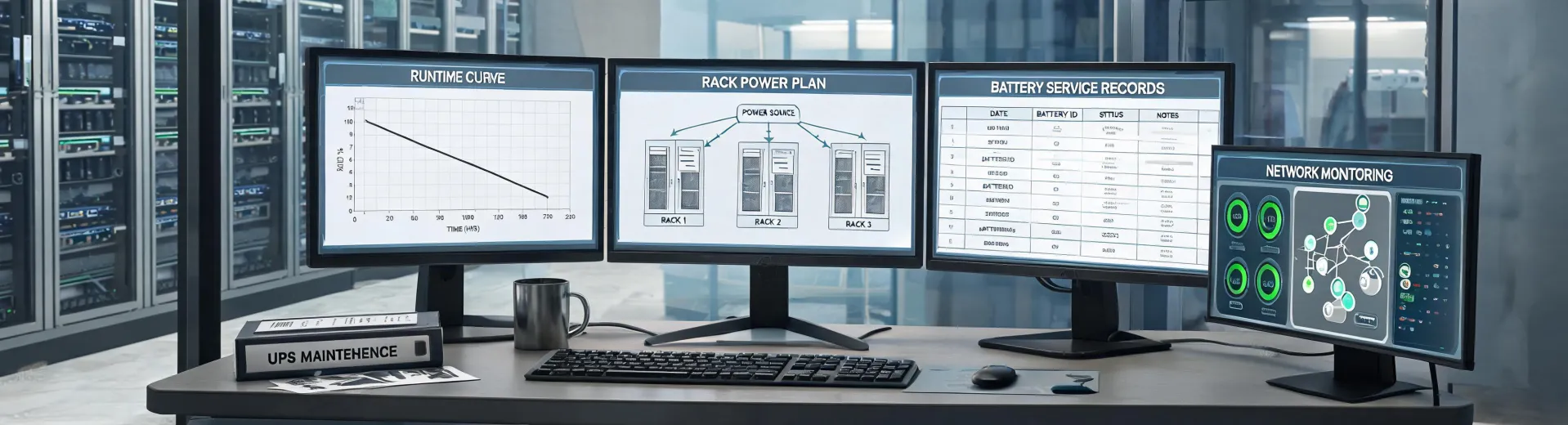
Most buyers focus on the VA number and completely miss wattage and runtime. VA and watts are not the same thing. A 1000VA model is not a 1000W model. The spec sheet lists the actual wattage rating, and the same sheet has a runtime chart that changes with the load. Two different “1000VA” units can behave very differently at the same real-world load.
The question everyone asks is, “which model should I buy?” The question they should ask is, “what is my load, and how long do I need it to run?” That answer narrows the choice faster than any keyword search.
Lithium UPS: Better Battery, Same Homework
Once the vendor consolidation moved to battery chemistry, lithium entered every conversation. I lost count of how many links included the phrase lithium ups manufacturer somewhere in the page. The question from our office managers was always the same: “should we be buying lithium now?”
I went back and forth on this for two weeks. On paper, lithium makes sense: smaller footprint, lighter weight, longer service life, and better heat tolerance. The upside was a UPS that could outlast several budget cycles without a battery replacement. The risk was paying upfront for a benefit we might never fully use if equipment gets refreshed on a shorter cycle. We approved lithium for one cramped network closet where space was the real constraint. Everywhere else we kept the conventional lead-acid units. Not the flashiest decision, but a deliberate one.
Here’s something vendors won’t tell you: a lithium UPS is only as good as its battery management system. The cells are part of the story, but charging, cell balancing, and temperature protection are what keep those cells alive. When I evaluate a lithium ups manufacturer, I now ask who designed the battery management system, which certifications the product carries, and exactly what the warranty covers. If the answer is vague, I keep looking.
OEM vs Private Label: The Question I Learned From Solar Inverters
Earlier this year, our facilities team asked me a search-style question: solar inverter OEM vs private label—what’s the difference? They had two quotes for similar-looking equipment. One quote came from the company that designs and manufactures the unit. The other came from a company that buys the unit and puts its own brand on it. Both products can perform fine. But ongoing support, firmware updates, and warranty accountability depend on who actually controls the design.
The same logic applies to UPS buying. “Manufacturer” is a loose word in power equipment. When I look at an APC UPS by Schneider Electric, I know the OEM is accountable: the spec sheets are public, the support structure is documented, and the warranty process is established. If I were buying from a private-label seller, I would ask the same questions before signing—not after the unit fails.
And While We’re At It: A UPS Is Not a Charger
One more confusion shows up when someone tries to build a “UPS” from parts. A while back, a site supervisor suggested connecting a heavy-duty battery charger to a deep-cycle battery to keep security cameras running during outages. I get the appeal. The parts are cheaper, and the charger does keep a battery topped up. But a charger cannot detect a utility failure and switch the load to battery in milliseconds. A UPS combines a charger, an inverter, and a transfer switch designed for exactly that job. If your equipment needs to stay online or shut down cleanly, that transfer switch is the whole point.
Is This Overkill for a Box of Batteries?
At this point, someone usually says I’m overcomplicating things. “A UPS either works when the power goes out or it doesn’t,” they say. “Buy one with good reviews and move on.”
I understand. I also know that a UPS only reveals its weaknesses when the power is already gone. There is no second chance to compare specs during an outage. Reading one runtime chart before placing the order takes five minutes.
Am I saying every office needs a premium three-phase system? No. In many cases, a standard APC UPS 1000VA unit is exactly the right fit, and I order them when the load is modest and the runtime expectations are realistic. The point is to make the decision from the spec sheet out, not from the search result in.
I would rather spend ten minutes explaining capacity and runtime to a colleague than explain to my VP why our new “backup power” didn’t back anything up. Know the load. Know the runtime. Know who actually makes the product. Then pick the model—not the other way around.

Rebecca Sloan
Rebecca Sloan is a power distribution and protection analyst specializing in circuit breakers, switchgear, contactors, fuses, surge protective devices, and coordination. She applies IEC 60947-2 breaker requirements, IEC 60269 fuse characteristics, and IEC 61643-11 tests while examining rated voltage, breaking capacity, time-current curves, selectivity, and prospective short-circuit current. She helps engineers and buyers compare protective devices against documented fault levels, installation conditions, maintenance access, and continuity priorities.